
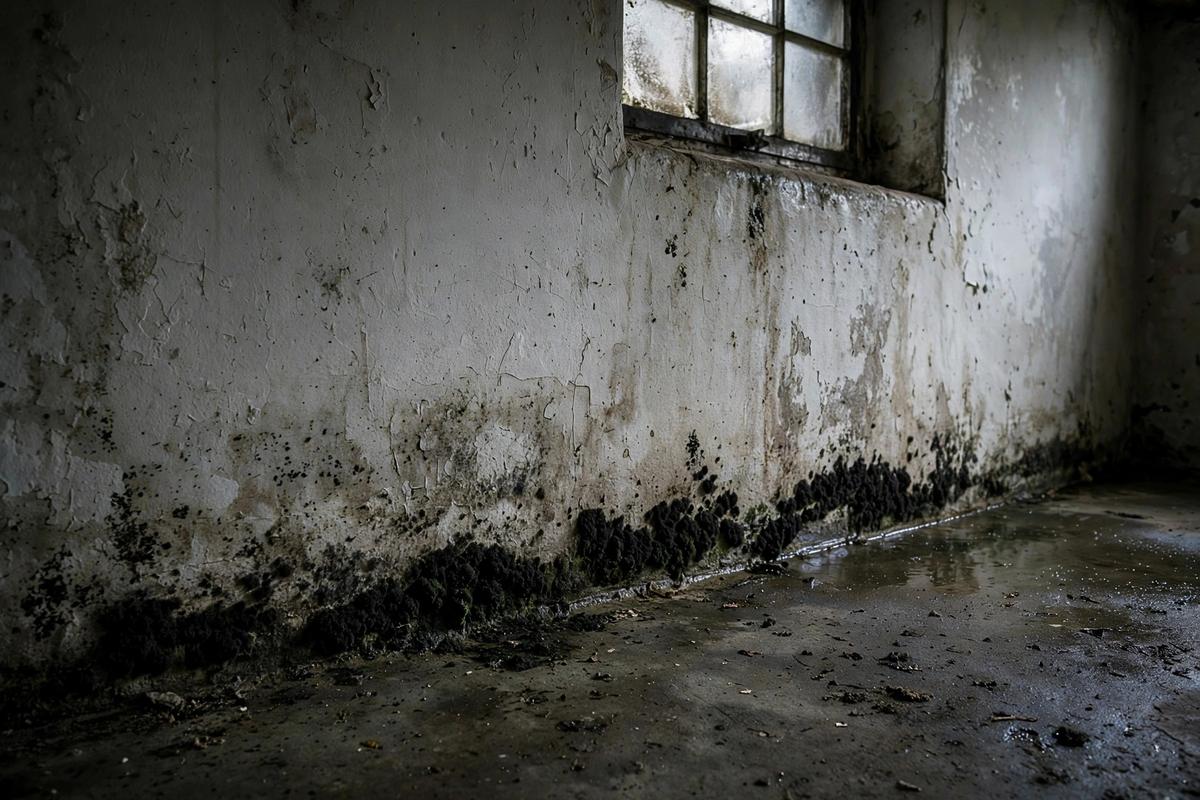
What basement mold removal means
Basement mold removal follows the same principles as mold remediation elsewhere, with basement-specific complications: the water source is often a seep rather than a leak, the affected materials include foundation walls and framing that cannot simply be removed, and finished basements hide growth behind drywall that looks clean from the room side.
The work therefore starts with the basement's water story. Wall-floor joint seepage, window well overflow, foundation cracks, plumbing in the basement, condensation on cold walls and pipes, and past floods each leave different patterns, and each needs a different fix. Removing growth without naming the path invites a return visit to the same wall.
This page covers basement moisture paths, what gets removed versus cleaned in a basement, and how drying is verified in a space that dries slowly by nature. If the basement has standing water or sewage, address that first — see flooded basement cleanup and sewage backup cleanup — before any mold work begins.
How basement mold removal works
The assessment maps both growth and moisture. Growth on the room side of finished walls is only part of the picture: the wall cavity, the wall-floor joint, window wells, and the slab edge are all checked with moisture readings, because basement growth often lives where the eye cannot reach. The pattern of readings usually points at the path — a joint line suggests seepage, a diffuse pattern suggests humidity or condensation.
Containment and removal follow the same rules as elsewhere, adapted to basements: the work area is isolated, porous materials that are heavily affected are removed, and hard surfaces — concrete, block, framing that is sound — are cleaned. In finished basements, this often means opening sections of drywall to reach the cavity, because cleaning the room-side surface while the cavity stays wet and affected solves nothing.
Drying a basement takes longer than drying an upper room, and verification matters more for the same reason. Dehumidification and air movement run until readings stabilize, not until the surface feels dry, and the moisture fix — grading, drainage, window well, plumbing, or humidity control — is named before rebuilding. New drywall over a damp foundation wall repeats the original failure.
Warning signs — basement mold
- Musty odor strongest at the bottom of the stairs. Basement odor that greets you on descent usually comes from the basement itself, not the upstairs.
- Discoloration along the wall-floor joint. The joint is the most common seep path and the most common growth line.
- White mineral deposits (efflorescence) on walls. Mineral trails prove water has moved through the wall, even when the wall looks dry now.
- Peeling paint or bubbling on basement walls. Moisture pushing coatings off block or drywall.
- Warped baseboards or soft lower drywall. The bottom foot of basement walls shows moisture first.
- Condensation on walls, pipes, or windows. Ongoing surface moisture in a cool basement feeds growth steadily.
- Growth behind stored boxes or furniture. Undisturbed, low-airflow spots against exterior walls are classic hiding places.
- Stains after storms or spring thaw. Weather-linked patterns point at seepage and drainage paths.
Common causes in Herriman-area homes
Seepage at the wall-floor joint is the leading basement moisture path in general, and it behaves differently from a leak: it appears after storms or thaw, it follows the joint line, and it can be intermittent for years before anyone connects it to the musty smell. Window wells are the second path — a well that fills faster than it drains sends water straight to the wall and the basement floor.
Plumbing in the basement is the third path, and the most fixable: laundry connections, water heaters, softeners, and floor drains all sit in basements, and a slow failure there feeds the same walls as seepage does. The pattern separates them: plumbing moisture is steady and tied to fixture use, while seepage follows weather.
Humidity and condensation are the quiet fourth path. A cool basement in a humid season sweats on walls, pipes, and ductwork, and finished basements trap that moisture behind drywall. A basement can grow mold with no leak at all if humidity stays high and airflow stays low for long enough.
Safe first steps before anyone arrives
Do not tear out finished basement walls or scrub large growth areas yourself. Basement growth often covers more area behind the wall than in front of it, and disturbing it without containment spreads spores through the home, including upstairs through stairwells and HVAC paths.
- Note when moisture appears: after rain, after thaw, all the time, or only in humid weather.
- Photograph growth, stains, mineral deposits, and the wall-floor joint without moving heavy stored items into living areas.
- Keep the basement door closed where possible to limit spore movement upstairs.
- Do not store clean belongings against suspect walls, and do not cover growth with paint or sealant.
- If water is standing, address the water first and keep people out of it.
The visit step by step
- Review the basement's water history: storms, thaws, plumbing events, and past floods.
- Map growth and moisture, including the wall-floor joint, window wells, and wall cavities.
- Identify the moisture path: seep, plumbing, condensation, or past event.
- Set containment to protect the rest of the home, including upstairs paths.
- Remove porous materials that cannot be cleaned reliably, opening finished sections where needed.
- Clean hard surfaces and sound framing within the contained area.
- Dry with dehumidification and air movement until readings stabilize.
- Name the moisture fix that prevents return before any rebuilding.
Cost factors (no prices listed)
| Factor | What it changes |
|---|---|
| Affected wall area | A single wall section differs from a full perimeter or multiple rooms. |
| Finished vs unfinished | Opening finished walls differs from working on exposed block or concrete. |
| Moisture path | A fixed plumbing leak differs from an ongoing seep needing drainage attention. |
| Material removal | Drywall, insulation, and stored items scale with what was affected. |
| Drying duration | Basements dry slower, so drying scope differs from upper rooms. |
| Rebuilding scope | Replacement finishes depend on how much was opened. |
We do not publish dollar amounts. Confirm scope on the call at (801) 555-0132.
When basement mold needs urgent attention
Rapidly spreading growth, sewage involvement, standing water, and growth near HVAC equipment or bedrooms all justify a prompt call. Keep the basement closed off where possible and call (801) 555-0132. For active water, see emergency water extraction first.
FAQ — Basement Mold Removal
Why does basement mold keep coming back?
Almost always because the moisture path was never fixed. Growth returns to the same wall when seepage, condensation, or a plumbing issue still feeds it — removal without a moisture fix is temporary.
Can I just paint over basement mold with sealant?
No. Sealant over growth traps moisture and hides the problem; growth continues behind the coating and the moisture path stays active.
Does a finished basement make mold harder to remove?
Yes, because growth hides in the wall cavity behind drywall that looks clean. Finished sections often need to be opened to reach and dry the cavity properly.
What is the white powder on my basement walls?
Usually efflorescence — mineral deposits left when water moves through masonry and evaporates. It proves water has traveled through the wall, even if the wall feels dry now.
Do I need to fix drainage before mold removal?
The moisture fix should be identified before rebuilding, though removal and cleaning can often proceed while a drainage plan is arranged. Rebuilding before the fix invites a repeat.
What should I have ready when I call?
Where growth and moisture appear, whether they follow weather or stay constant, any past floods or leaks, whether the basement is finished, and your Herriman-area ZIP.
Related services
Continue with Mold Remediation, Mold Inspection, Flooded Basement Cleanup, Mold Testing. Return to water damage repair in Herriman for the full overview.
Herriman notes for basement mold removal
For basement mold removal in Herriman, UT, the wall-floor joint is where the story usually starts. Basements here combine soil moisture, seasonal thaw and storms, and finished walls that hide the joint from view — so growth along the bottom foot of a wall, mineral deposits on block, and a musty stairwell are often one problem with one path. Check the joint and the window wells before assuming a plumbing leak or a humidity problem alone.
Finished basements deserve a specific warning: the room-side surface is the least reliable evidence in the house. Drywall that looks clean can hide a wet, affected cavity, and the only honest assessment includes moisture readings on the wall and, where readings justify it, opening a section to look. A plan that cleans only what is visible in a finished basement is a plan that will be repeated.
When comparing options, weigh the moisture fix against the removal scope. A thorough removal without a named fix for the seep, condensation, or plumbing path will see growth return to the same wall, while a smaller removal paired with a real fix holds. Call (801) 555-0132 to start basement mold removal in Herriman, UT.