
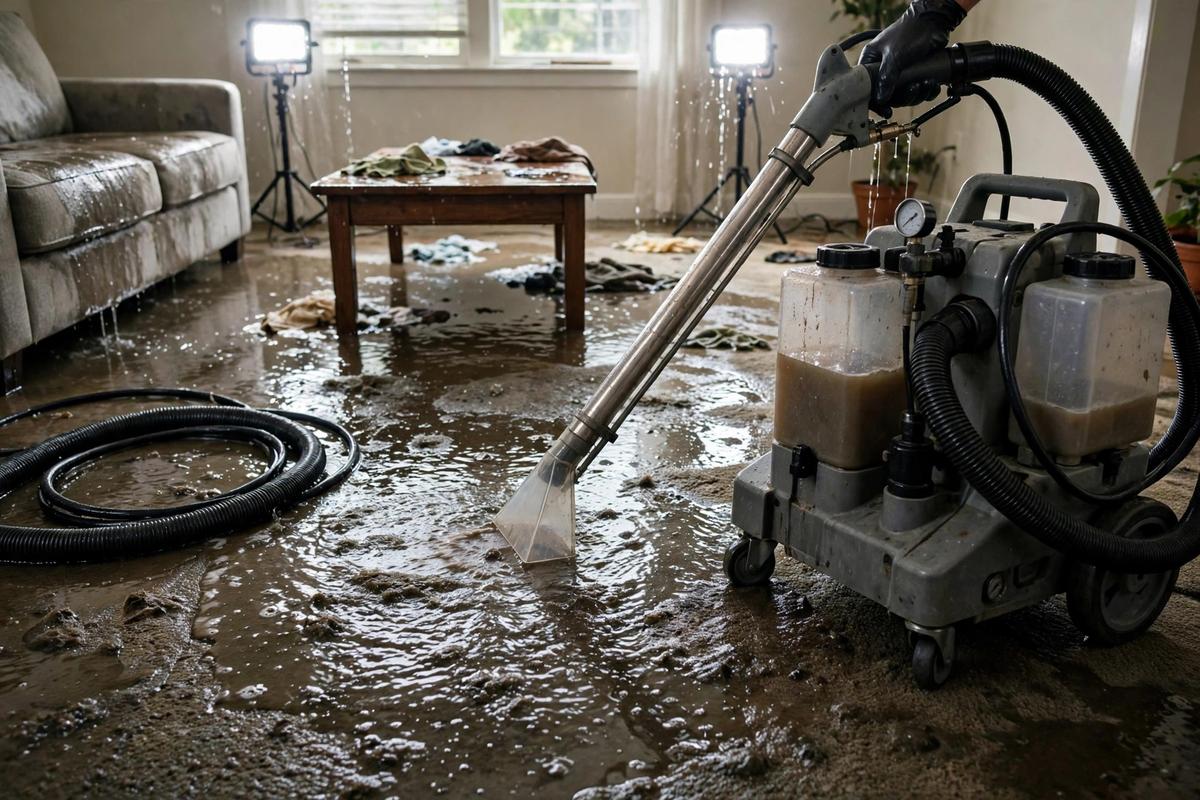
What emergency water extraction means
Extraction is the physical removal of standing and absorbed water using pumps, truck-mounted or portable extractors, and wet vacuums. It is the first phase of water damage work, not the whole job: extraction gets the bulk water out, and drying, cleaning, and repair follow on the smaller area that remains wet.
The word emergency here refers to urgency, not to a promised arrival time. Water that is spreading, water near electrics, sewage-contaminated water, and water from an uncontained source all justify treating the call as urgent and acting on safety and shutoffs first. This page does not promise a specific response time — it explains what to do while help is on the way and what the extraction visit itself involves.
Extraction differs by water type. Clean water from a supply line is handled differently from gray water from appliances, and both differ from sewage-contaminated water, which follows the sewage backup cleanup sequence instead. Naming the water source on the call helps the visit start with the right equipment and protection.
How extraction works
The visit starts with safety and source control: electrics near water are avoided, the water source is shut off where it can be reached safely, and the affected area is assessed for depth, spread, and water type. Furniture and belongings are moved out of the water path where possible, and the wet footprint is mapped so extraction covers the full area, not just the visible puddle.
Bulk water is removed first with pumps or high-volume extractors, then absorbed water is pulled from carpet, padding, and flooring with extraction wands and weighted tools. Carpet padding that is saturated often cannot be dried reliably and is removed; carpet itself may be lifted to dry the floor beneath. Hard floors are extracted and then dried, with attention to seams and edges where water hides.
Extraction ends with a moisture map, not with a dry-looking floor. Readings are taken on walls, floors, and baseboards to define what still needs drying, because the drying phase that follows works from that map. A home that looks dry but reads wet will keep feeding damage behind baseboards and under flooring.
When extraction is the right call
- Standing water on any floor. Any depth of standing water justifies extraction rather than towels.
- Water spreading across rooms. A footprint that grows between checks means the source or the spread is still active.
- Soaked carpet or padding. Carpet that squelches underfoot holds far more water than its surface shows.
- Water near electrics or gas appliances. Safety first: keep clear and call rather than entering the water.
- Water coming through a ceiling. Ceiling saturation above means extraction below plus source control above.
- A burst pipe or failed appliance hose. High-volume sources saturate faster than mopping can follow.
- Water under flooring or behind baseboards. Hidden water keeps spreading while the surface looks manageable.
- Any sewage-contaminated water. Handled under the sewage sequence, with extraction as its first step.
Common causes in Herriman-area homes
Burst or failed supply lines are the most common high-volume cause: appliance hoses, toilet supply lines, and water heater connections release large amounts of water quickly, and the damage scales with how long the flow ran before it was found. A hose failure discovered after a workday looks very different from one found within minutes.
Appliance and fixture failures follow: dishwashers, washing machines, water heaters, and HVAC condensate lines each have their own failure patterns, and each leaves a characteristic footprint. Dishwasher leaks hide under cabinets; washing machine failures flood laundry rooms and the rooms below; condensate problems show up slowly and then all at once.
Exterior water completes the set: storms, window well overflow, and foundation seepage bring water in at the lowest level, usually basements. These events often arrive with less warning and more sediment, which changes cleaning as well as extraction.
Safe first steps before anyone arrives
Do not enter standing water that may reach electrics, and do not wade through water of unknown depth or contamination. Safety comes before salvage: belongings can be replaced, and a shock or contamination exposure cannot be undone.
- Shut off the water source if you can reach it safely and without entering the water.
- Shut off power to affected rooms only if the panel is dry and you can reach it without stepping in water.
- Move dry belongings, electronics, and rugs out of the water path where you can do so safely.
- Photograph the water depth, the spread, and the apparent source for the visit and your records.
- Do not run household fans on standing water — they spread moisture and, with contaminated water, contamination.
The visit step by step
- Confirm safety around electrics, gas, and water depth before entering the area.
- Stop or document the water source and shut off affected utilities where needed.
- Map the wet footprint, including walls, flooring, and rooms beyond the visible puddle.
- Remove bulk standing water with pumps or high-volume extractors.
- Extract absorbed water from carpet, padding, and flooring.
- Remove saturated padding and other materials that cannot be dried reliably.
- Take moisture readings to define the drying phase that follows.
- Set drying equipment and explain what happens next, including cleaning and repair scope.
Cost factors (no prices listed)
| Factor | What it changes |
|---|---|
| Water volume and depth | A shallow room differs from several inches across multiple rooms. |
| Water type | Clean water differs from gray water and from sewage-contaminated water. |
| Flooring types | Carpet extraction differs from hard floors and from flooring that must be lifted. |
| Spread beyond the source room | One room differs from water that traveled to adjacent rooms or lower floors. |
| Material removal | Padding and soaked materials add scope beyond extraction alone. |
| Drying that follows | Extraction is phase one; the drying phase scales with the moisture map. |
We do not publish dollar amounts. Confirm scope on the call at (801) 555-0132.
When to call urgently
Call urgently when water is spreading, when it is near electrics or gas appliances, when sewage is involved, when a ceiling is sagging under water weight, or when the source cannot be shut off. Keep people and pets clear of the water, shut off what you can safely shut off, and call (801) 555-0132. For sewage specifically, see sewage backup cleanup.
FAQ — Emergency Water Extraction
Should I wait for the water to stop before calling?
No. Call while water is still coming in if you can do so safely — source control advice and extraction planning start on the call, and the visit can proceed once the area is safe to enter.
Can I use towels and a wet vacuum instead?
For a very small spill, yes. For standing water, soaked carpet, or water that has spread beyond one small area, professional extraction removes far more water, including what is absorbed into padding and subfloors.
Do you remove carpet during extraction?
Saturated padding is usually removed because it cannot be dried reliably. Carpet itself is often lifted to dry the floor beneath and may be restorable depending on water type and condition.
How long does extraction take?
It depends on volume, spread, and flooring. The visit can give a scope once the footprint is mapped; drying after extraction is a separate phase that takes longer.
Is extraction the whole job?
No. Extraction removes bulk water. Drying, cleaning, and repair follow, each scoped from the moisture map taken at the end of extraction.
What should I have ready when I call?
The water source if known, how deep and how widespread the water is, whether sewage is involved, whether electrics are affected, and your Herriman-area ZIP.
Related services
Continue with Flooded Basement Cleanup, Ceiling Water Damage Repair, Sewage Backup Cleanup, Water Damaged Drywall Repair. Return to water damage repair in Herriman for the full overview.
Herriman notes for emergency water extraction
For emergency water extraction in Herriman, UT, the first question is always the source, and the second is the lowest point. Water runs downhill through a home, so a burst hose on an upper floor becomes a ceiling problem below and a flooring problem further below — and extraction scoped only to the room where water was first seen will miss the rooms it traveled to. Say where the water started and where it has reached; both ends of the path need mapping.
Two-story homes and finished basements change the footprint in Herriman more than any other factor. An upper-floor failure spreads across two levels, and a finished basement hides water behind drywall and under flooring long after the surface looks dry. If water reached a lower level at all, the moisture map must include it, even if the lower floor looks untouched.
When comparing options, weigh the moisture map against the speed of the first pass. Fast bulk removal without mapping leaves absorbed water in padding, subfloors, and wall bases — and that hidden water is what turns an extraction job into a mold job weeks later. A visit that extracts, maps, and then sets a drying plan is the one that actually ends the event, so call (801) 555-0132 to start emergency water extraction in Herriman, UT.