
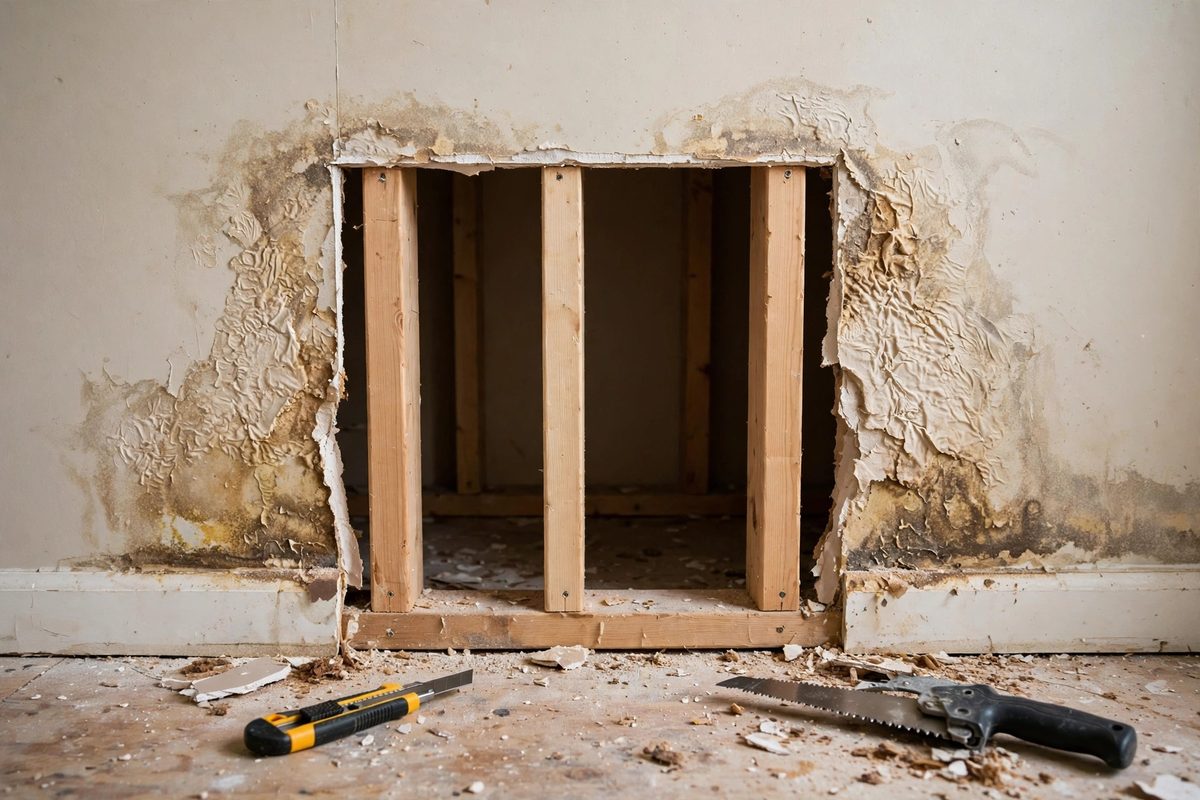
What water damaged drywall repair means
Drywall is gypsum board faced with paper, and both parts react badly to prolonged wetting: the gypsum softens and loses strength, and the paper facing supports mold growth once it stays damp. Repair therefore means assessing the board and the cavity behind it, drying what can be saved, removing what cannot, and restoring the surface with matching finish.
The key decision on every job is dry-in-place versus cut-out. Drywall that got briefly wet and dried promptly can often be saved. Drywall that stayed wet for days, that sags or crumbles, that shows growth, or that sat in contaminated water generally cannot — and no amount of paint makes it sound again. That decision is made with moisture readings and firmness checks, not by appearance alone.
This page covers assessment, the flood-cut technique, drying verification, and finish matching. If the drywall is in a ceiling and sagging, treat it as urgent and see ceiling water damage repair as well — ceiling boards fail under their own weight when saturated.
How drywall repair works
Assessment comes first: moisture readings across the affected wall and beyond the visible stain, firmness checks by hand, and a look at the cavity where possible. The wet footprint in drywall almost always extends past the stain, because the board wicks water upward and sideways from the entry point. Marking the full footprint before cutting prevents a second opening later.
Where removal is needed, the standard approach is a flood cut: a straight, level cut above the highest moisture line, removing the damaged lower section while leaving sound board above. Cutting straight and level matters because it makes the replacement piece fit cleanly and the finish blend. Insulation behind the removed section is assessed too — wet insulation is usually removed, since it dries slowly and holds moisture against framing.
Drying follows removal, not the other way around: framing, the remaining board edges, and the cavity are dried and verified with readings before new board goes in. New drywall is then installed, taped, finished, and textured to match, and painting waits until everything reads dry. A wall closed up damp will show the repair as a stain within weeks.
Warning signs — damaged drywall
- Yellow-brown stains or rings. The first and most common sign of water reaching the board.
- Soft spots that dent under light pressure. Softened gypsum has lost strength and will not recover it.
- Bubbling, peeling, or blistering paint. Moisture pushing coatings off the board surface.
- Sagging, especially in ceilings. Saturated board sags under its own weight and can fail.
- Crumbling edges or corners. Board that breaks apart easily has been wet too long to save.
- Musty odor from the wall. Damp paper facing and cavity moisture behind a surface that looks only stained.
- Baseboards pulling away or warping. Trim wicks moisture and shows it before the wall field does.
- Stains that return after repainting. Proof the board or cavity was never dried.
Common causes in Herriman-area homes
Plumbing leaks are the leading cause: supply and drain lines inside walls feed drywall slowly and steadily, often for weeks before a stain appears. Bathrooms are the usual origin — shower surrounds, toilet bases, and sink connections — with the damage showing up on the wall below or beside them rather than at the fixture itself.
Exterior water is the second cause: roof and window leaks, and in basements, seepage that wicks up the lower board. Basement drywall deserves special caution because the bottom foot of board sits in the seep zone; a stain at baseboard height in a basement is often a seep problem, not a plumbing problem.
Appliance and HVAC water complete the set: laundry hoses, dishwasher lines, water heaters, and condensate drains all route near or through drywall, and their failures wet the board from behind. In each case, the board is the messenger, not the cause — fixing the board without fixing the source repeats the job.
Safe first steps before anyone arrives
Do not press, poke, or cut sagging drywall yourself, especially in ceilings: saturated board can release water and debris without warning, and the cavity may hold wiring or plumbing. Keep the area clear and let assessment come first.
- Photograph stains, soft spots, and the full wall, including nearby fixtures and the room above or beside.
- Note when the damage appeared and whether it follows fixture use, rain, or no pattern.
- Move furniture and belongings away from the wall so the full footprint is visible.
- Do not repaint the stain — paint hides the moisture pattern that assessment needs.
- If the board is sagging in a ceiling, keep people out from under it.
The visit step by step
- Assess moisture across the wall and beyond the visible stain, plus firmness of the board.
- Trace the water source and confirm it is stopped or documented for repair.
- Decide dry-in-place versus cut-out, board section by board section.
- Make flood cuts straight and level above the moisture line where removal is needed.
- Assess and remove wet insulation behind removed sections.
- Dry framing, remaining board, and the cavity, verifying with readings.
- Install replacement board, tape, finish, and match texture.
- Confirm everything reads dry before painting, and recheck after drying.
Cost factors (no prices listed)
| Factor | What it changes |
|---|---|
| Damaged area size | A small stain section differs from full-wall or multi-room replacement. |
| Ceiling vs wall | Ceiling work differs from wall work in access and safety handling. |
| Insulation condition | Sound insulation differs from wet insulation that must be removed. |
| Finish matching | Flat paint differs from textured finishes that need blending. |
| Cavity drying | Surface drying differs from cavity and framing drying. |
| Source repair | A stopped leak differs from a source needing separate trade work. |
We do not publish dollar amounts. Confirm scope on the call at (801) 555-0132.
When drywall damage is an emergency
Sagging ceilings, large soft sections, water near electrics, and any sewage contamination all justify an urgent call. Keep clear of sagging areas and call (801) 555-0132. For standing water, see emergency water extraction; for contamination, see sewage backup cleanup.
FAQ — Water Damaged Drywall Repair
Can wet drywall dry out and be saved?
Sometimes. Board that got briefly wet and dried promptly can often be saved. Board that stayed wet for days, sags, crumbles, or shows growth generally cannot — moisture readings and firmness decide, not appearance.
What is a flood cut?
A straight, level cut above the highest moisture line, removing the damaged lower section of drywall while leaving sound board above. It gives a clean edge for replacement and a reliable finish.
Why does the stain extend past the leak?
Drywall wicks water upward and sideways from the entry point, so the wet footprint is almost always larger than the visible stain. Assessment maps the full footprint before cutting.
Do I need to replace insulation behind wet drywall?
Often, yes. Wet insulation dries slowly and holds moisture against framing, so it is usually removed when the board in front of it is cut out.
Can I just paint over a water stain?
Paint hides the stain without drying the board or cavity, and the stain usually returns. Stain-blocking primer has a place — after drying is verified, not instead of it.
What should I have ready when I call?
Where the damage is, how it appeared and when, what sits on the other side of the wall, whether the board sags or feels soft, and your Herriman-area ZIP.
Related services
Continue with Ceiling Water Damage Repair, Mold Remediation, Emergency Water Extraction, Basement Mold Removal. Return to water damage repair in Herriman for the full overview.
Herriman notes for water damaged drywall repair
For water damaged drywall repair in Herriman, UT, the wicking pattern is the detail that most often surprises homeowners. A leak at a bathroom baseboard can wet drywall a foot or more up the wall and sideways into the next room, so a stain that looks small can hide a footprint several times its size. Assessment that maps moisture past the stain is what keeps a repair to one opening instead of two.
Basement drywall deserves a separate note: the bottom foot of board in a basement lives in the seep zone, and a stain at baseboard height there is often seepage rather than plumbing. Cutting that section without addressing the seep path means cutting it again next season. Say whether the stain follows weather or stays constant — that timing separates the two causes.
When comparing options, weigh drying verification against a fast patch. A wall finished and painted while the cavity is still damp will show the stain again and can support growth behind the new surface. A repair that dries, verifies, and then finishes is the one that lasts, so call (801) 555-0132 to start water damaged drywall repair in Herriman, UT.