
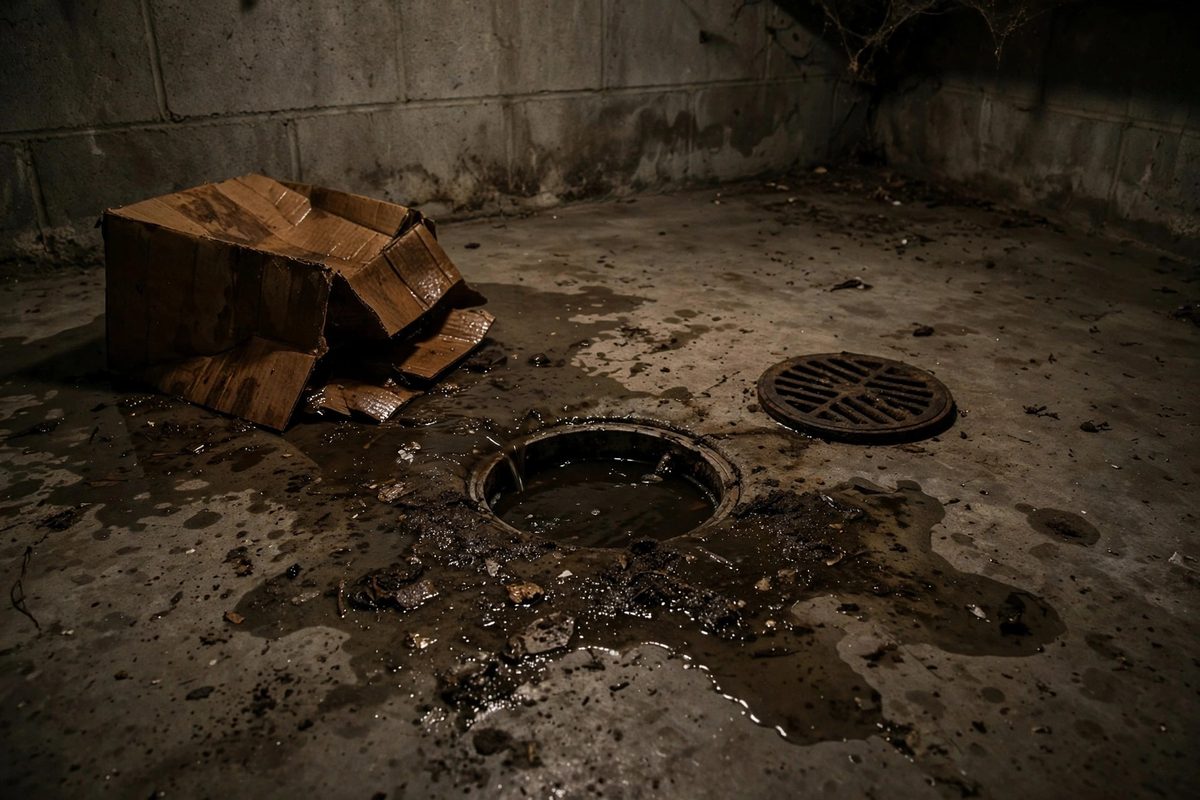
What sewage backup cleanup means
A sewage backup happens when wastewater flows back into a home through a floor drain, toilet, or lower-level fixture, usually because of a blockage, a overwhelmed line, or a problem in the main sewer connection. The water involved is contaminated: it can carry bacteria and other harmful material, which changes every step of the response compared with a clean-water leak.
Cleanup therefore has a different order of operations. The inflow must be stopped before anything is dried or rebuilt. Contaminated porous materials — carpet padding, soaked drywall, insulation, and similar items — are generally removed rather than cleaned, because contamination cannot reliably be washed out of them. Hard surfaces are cleaned and disinfected, and the area is dried only after contamination is addressed.
This page covers what to do immediately, what not to do, how the cleanup sequence works, and when a backup points to a plumbing problem that needs its own repair. If sewage is actively entering the home, keep people and pets out of the affected area and call (801) 555-0132 promptly.
How the cleanup sequence works
Safety and isolation come first. The affected area is closed off, the home's HVAC is kept from spreading contaminated air, and protective gear is used for all handling. Fixtures that feed the backup are not used until the inflow is stopped, because every additional flush or drain cycle adds to the problem.
Extraction removes the standing contaminated water, and removal follows: porous materials that absorbed sewage are taken out and disposed of from the contained area. This is the step homeowners most often underestimate — a carpet that looks cleanable after sewage exposure usually is not, and drywall that wicked sewage upward must be cut back to clean material.
Cleaning and drying come last, in that order. Hard surfaces are cleaned and disinfected, the structure is dried, and moisture readings confirm the area is dry before any rebuilding. Rebuilding over a damp, contaminated cavity repeats the failure and leaves the contamination in place.
Warning signs — sewage backup
- Water or waste coming up through a floor drain. The most direct sign, especially in basements and lower levels.
- Toilets gurgling or bubbling when other fixtures drain. Air forced back through traps signals a downstream blockage.
- Multiple fixtures draining slowly at once. One slow sink is local; several together point to a main-line problem.
- Sewage odor from drains, especially on lower floors. A persistent smell that worsens with fixture use.
- Water appearing in a tub or shower when a toilet flushes. Cross-fixture behavior is a strong backup indicator.
- Wet spots or waste residue around a floor drain. Even a small backup leaves marks worth noting.
- Backups that return after plunging. A problem that clears briefly and returns is downstream of the fixture.
- Yard or cleanout overflow near the home. Waste at an exterior cleanout points to the main line, not a single fixture.
Common causes in Herriman-area homes
Most residential backups come from the main line rather than a single fixture: grease and debris buildup, root intrusion into older lines, flushed items that do not break down, and structural problems in the lateral line. Lower-level fixtures show the problem first because they sit closest to the main, which is why basements and ground-floor bathrooms are the usual scene.
Heavy water use can expose a partial blockage that otherwise goes unnoticed. Laundry cycles, showers, and dishwashers running together push more volume through a narrowed line, and the backup appears at the lowest drain. That pattern — fine most days, backing up under load — is a useful detail on the call.
Storm and groundwater inflow can also overwhelm lines in some homes, especially where downspouts or yard drainage connect to the sewer system. If backups follow heavy rain, say so: the fix may involve drainage routing as well as the line itself.
Safe first steps before anyone arrives
Do not enter standing sewage water, do not try to mop it, and do not use fixtures that feed the backup. Sewage exposure carries health risks that clean water does not, and household cleaning cannot make a contaminated area safe by itself.
- Keep people and pets out of the affected rooms and close doors to contain the area.
- Stop using toilets, showers, laundry, and dishwashers that drain toward the backup.
- If you can safely reach the main water shutoff, closing it will not stop a sewer backup but can limit added water from fixtures.
- Photograph the backup, the affected fixtures, and any visible cleanout or drain, without entering the water.
- Move clean belongings out of the path only if you can do so without stepping in contaminated water.
The visit step by step
- Confirm safety, isolate the area, and stop additional fixture use.
- Identify whether the backup is a fixture problem, a branch problem, or a main-line problem.
- Extract standing contaminated water with appropriate protective measures.
- Remove porous materials that absorbed contamination, cut back to clean material.
- Clean and disinfect hard surfaces and remaining structure.
- Dry the area and verify with moisture readings until stable.
- Document the affected scope for any plumbing repair that must follow.
- Confirm the area is clean and dry before rebuilding or reusing fixtures.
Cost factors (no prices listed)
| Factor | What it changes |
|---|---|
| Contamination extent | A single drain area differs from several rooms or a full basement. |
| Material removal volume | Carpet, padding, and drywall removal scale with what absorbed sewage. |
| Line problem scope | A cleared blockage differs from a lateral repair that follows cleanup. |
| Drying extent | Surface drying differs from cavity, slab, and framing drying. |
| Disinfection scope | Hard-surface cleaning differs from full-area treatment after heavy contamination. |
| Rebuilding scope | Replacement finishes depend on how much material was removed. |
We do not publish dollar amounts. Confirm scope on the call at (801) 555-0132.
When a sewage backup is an emergency
Active sewage entering living space, backups affecting toilets or kitchens, and any backup in a home with children, elderly residents, or anyone with health vulnerabilities all justify an urgent call. Keep the area closed off, do not use the fixtures, and call (801) 555-0132. If standing water is also present, see emergency water extraction.
FAQ — Sewage Backup Cleanup
Can I clean up a small sewage backup myself?
Small, contained backups are sometimes handled by homeowners with proper protection, but anything beyond a very small area, any backup involving a toilet, or any situation where water reached walls and flooring deserves professional handling because contamination hides in porous materials.
Why can't sewage-soaked carpet just be cleaned?
Carpet padding and similar porous materials absorb contamination deep into their structure, where surface cleaning cannot reliably reach it. Removal is the safer course for anything that absorbed sewage.
Does the plumbing problem need fixing too?
Often, yes. Cleanup addresses the contamination; the blockage or line problem that caused the backup needs its own diagnosis, or the backup will return with the next heavy use.
How do I know if it is a main-line problem?
Multiple fixtures affected at once, gurgling across fixtures, and backups at the lowest drain all point to the main line rather than a single fixture.
Is it safe to stay in the home during cleanup?
It depends on the extent and whether the area can be isolated. The visit can advise on isolation; when in doubt, keep people out of affected rooms until cleaning is complete.
What should I have ready when I call?
Which fixtures are affected, whether the backup is active, whether it follows rain or heavy use, any cleanout or yard overflow, and your Herriman-area ZIP. Photos help triage.
Related services
Continue with Emergency Water Extraction, Flooded Basement Cleanup, Mold Remediation, Basement Mold Removal. Return to water damage repair in Herriman for the full overview.
Herriman notes for sewage backup cleanup
For sewage backup cleanup in Herriman, UT, the lowest drain tells the story. Basements and ground-floor bathrooms show backups first because they sit closest to the main line, so a backup that appears only in a basement floor drain is not a basement problem — it is usually a main-line problem showing itself at the lowest point. Say which fixtures are affected and whether they act up together; that pattern separates a fixture clog from a line problem faster than any single symptom.
Heavy-use timing is the second useful detail. Backups that appear during laundry cycles or when several fixtures run together point at a partial blockage that normal daily use does not expose. Backups that follow heavy rain point at inflow and drainage instead. Either way, cleanup and line diagnosis are two jobs: cleaning without fixing the line invites a repeat, and fixing the line without cleaning leaves contamination in place.
When comparing options, weigh isolation and removal thoroughness against speed. A quick mop and fan over sewage contamination leaves the real problem in padding, drywall, and cavities. A sequence that isolates, removes what absorbed contamination, disinfects hard surfaces, and verifies dryness is the one that makes the rooms safe to use again — call (801) 555-0132 to start sewage backup cleanup in Herriman, UT.