
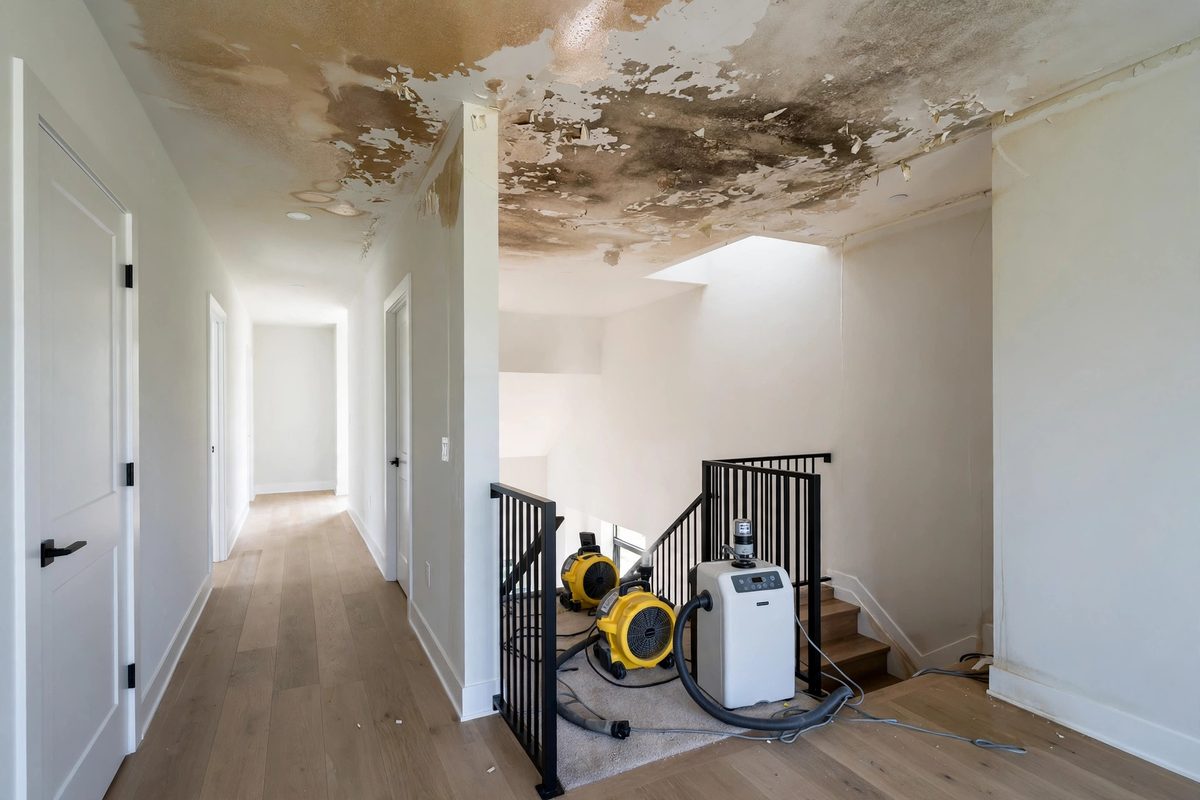
Why South Jordan water damage looks the way it does
Newer master-planned construction is the defining fact for South Jordan water damage, including Daybreak. These homes are built to modern standards with modern materials, but modern does not mean waterproof: appliance hoses, shower surrounds, toilet bases, and condensate lines still fail, and when they do, the water runs through two-story layouts and finished basements in predictable paths — upstairs failure to downstairs ceiling, and lower-level seepage to finished walls.
Finished basements are the second pattern, and the most consequential. In South Jordan, basements are often finished living space — bedrooms, playrooms, media rooms — rather than storage, so water hides behind drywall and under flooring instead of showing on concrete. A finished basement wall can hold cavity moisture for weeks while the room looks normal, and the repair involves opening the wall, not just drying the floor.
Daybreak deserves its own note within South Jordan, because it is a large master-planned community with its own mix of home types — townhomes, single-family homes, and condos — all built in the same newer era. That mix means Daybreak water damage spans the townhome shared-wall pattern, the two-story ceiling pattern, and the finished-basement pattern, sometimes in the same block. A Daybreak call therefore starts with the home type, not with a single assumed pattern.
What to check first in South Jordan
- Note the home type first. Townhome, single-family, or condo — including Daybreak homes — each has its own water path.
- Check the room above any ceiling stain. Two-story layouts put the source one floor up, not in the stained room.
- Check finished basement walls and baseboards. Warped baseboards and musty lower rooms point at cavity moisture.
- Note whether the home is in Daybreak. Daybreak's mix of home types changes which pattern applies.
- Photograph stains together with the room above and the finished wall below. Both ends of the path help triage.
Services South Jordan residents most often need
- Ceiling Water Damage Repair — Stains from upstairs rooms in two-story homes, traced to the floor above.
- Basement Mold Removal — Finished basement growth traced to seep, plumbing, or humidity paths.
- Flooded Basement Cleanup — Finished basement flooding, from extraction through verified cavity drying.
- Mold Inspection — Musty finished levels mapped, including behind furniture and finished walls.
- Water Damaged Drywall Repair — Wet finished-wall drywall assessed, cut where needed, and restored.
- Emergency Water Extraction — Standing water in living areas, removed before finishes saturate further.
A South Jordan checklist that actually helps
- Know your home type: townhome, single-family, or condo, and whether it is in Daybreak
- Check rooms below bathrooms and laundry on a regular walk-through
- Note whether moisture follows fixture use, rain, or no pattern at all
- Check baseboards on finished lower walls for warping or pulling away
- Photograph stains together with the room above and the finished wall below
- Keep furniture a few inches off finished lower walls so moisture stays visible
Nearby areas
Also see Herriman Towne Center, Riverton, Bluffdale, Rosecrest. The water damage patterns overlap across the Herriman edge, but the layout — and therefore the first check — changes from one community to the next.
FAQ — South Jordan
Do you cover water damage calls in South Jordan?
Yes — South Jordan, north of Herriman, is covered on the Herriman call line, (801) 555-0132. Give your ZIP when you call so the visit is routed correctly.
Is Daybreak covered too?
Yes. Daybreak is a master-planned community inside South Jordan, so Daybreak calls are covered on the same South Jordan basis — mention Daybreak when you call so the home type is clear.
Why do newer South Jordan homes still get water damage?
Because modern systems still fail at hoses, surrounds, bases, and condensate lines — and newer closed cavities hide the water longer than older open construction would.
Are finished basements harder to assess?
Yes. Finished walls hide water in cavities behind drywall, while unfinished walls show moisture directly. Finished basements need cavity checks as part of the assessment.
Does the home type change the diagnosis in Daybreak?
Yes. Townhomes bring shared-wall patterns, single-family homes bring two-story ceiling patterns, and condos bring stacked-plumbing patterns — sometimes on the same block.
What should I tell you when I call from South Jordan?
Your home type and whether it is in Daybreak, where the stain or water is, what sits above it, whether lower walls are finished, and your ZIP. Photos help triage.
South Jordan notes for water damage repair
For water damage repair in South Jordan, UT, the home type is the detail that matters most — especially in Daybreak, where townhomes, single-family homes, and condos share the same newer era but not the same water paths. A stain in a Daybreak townhome can come from a shared wall, a stain in a two-story single-family home usually comes from the floor above, and a stain in a finished basement usually hides cavity moisture. Starting from the home type, rather than from a single assumed pattern, finds the source faster.
Finished basements are the second detail, because they turn a visible problem into a hidden one. A finished lower wall can look normal while its cavity stays wet, and the room-side surface is the last place to show it. Checking baseboards, furniture lines, and cavity moisture — not just the visible wall — is what separates a real assessment from a glance, and it is what keeps a family room usable long-term.
When comparing options, weigh the home-type assessment and the cavity check against a fast cosmetic fix. A wall dried and repainted while its cavity is still damp, or while a shared-wall source still feeds it, will show the problem again. A plan that names the home type, maps the full path, verifies dryness, and then finishes is the one that holds — call (801) 555-0132 to start water damage repair in South Jordan, UT, including Daybreak.